CARE ElderHome · for home health agencies

Know what happens between visits.

Continuous care at home. Camera-free monitoring that tells your nurses who needs them today, so problems are caught before they become hospital visits.

Care That Continues Between Visits

Periodic home-health visits leave most of the day unobserved, and consumer wearables rarely connect to clinical workflows or billing. Connected Care Systems pairs simple home sensors with software that learns each person's routine, so visiting nurses and families learn about falls, declining mobility and missed medications early, and can act before they become hospital visits.

Our platform, CARE ElderHome, is now in early deployments with home-health customers and in pilots in several markets.

For agency leaders

Fewer avoidable hospitalizations

Catch decline early and protect the quality scores that now adjust your Medicare payments, with reports you can use for QAPI and payer conversations.

For nurses

Know who needs you today

A roster ranked by risk, with the reason behind each flag. Routine changes wait for your next visit; only urgent ones interrupt.

For families

Peace of mind, without a camera

A simple daily view of how a parent's day went, in English, Chinese or Spanish, and a call when something isn't right.

Why It Matters

90%

of adults over 65 prefer to age in place, in their own homes.

Hours

Falls are a leading cause of injury death for older adults, and many go unnoticed for hours.

1 in 10

hospital admissions are linked, in part, to people not taking medications as prescribed.

How It Works

1
Enroll at start of care

Our team installs a small hub and sensors in the home, usually within days. Nothing to wear or charge, and no cameras or microphones.

2
Learn the routine

Over the first weeks, CARE learns each person's normal patterns: sleep, movement and gait, bathroom use, meals and medication.

3
Alert the right person

Changes are scored on a five-level urgency scale. Routine ones update the nurse's ranked roster; urgent ones go to your on-call team by text or phone.

4
Report and improve

Monthly summaries of alerts, falls, ED visits and hospitalizations, ready for QAPI, value-based reporting and payer conversations.

Our Platform

CARE ElderHome
In-Home Monitoring

A small home hub combines motion, environmental and optional wearable inputs into one stream, covering activity, gait, medication, doors, night-time activity, bathroom use and smoke. No cameras or microphones, and nothing the person has to remember to press.

CARE Engine
Clinical Reasoning

An adherence engine learns each person's normal routine and flags changes, scored on a five-level urgency scale. Gait analysis follows validated research methods, and alerts and trends are shared in the FHIR standard so they flow into existing clinical records.

Visiting Nurse Platform
For Home Health Teams

A mobile app that ranks each nurse's patient roster by risk, routes alerts by urgency into the agency's on-call process, and supports in-home documentation, even without a connection. Built to be HIPAA-compliant by design.

Inside the Dashboard

CARE ElderHome main dashboard: households under monitoring shown as cards with status, residents and their current room, and alert counts, with one household flagged critical
Every household at a glance: status, where each resident is right now, and open alerts. Problems rise to the top.
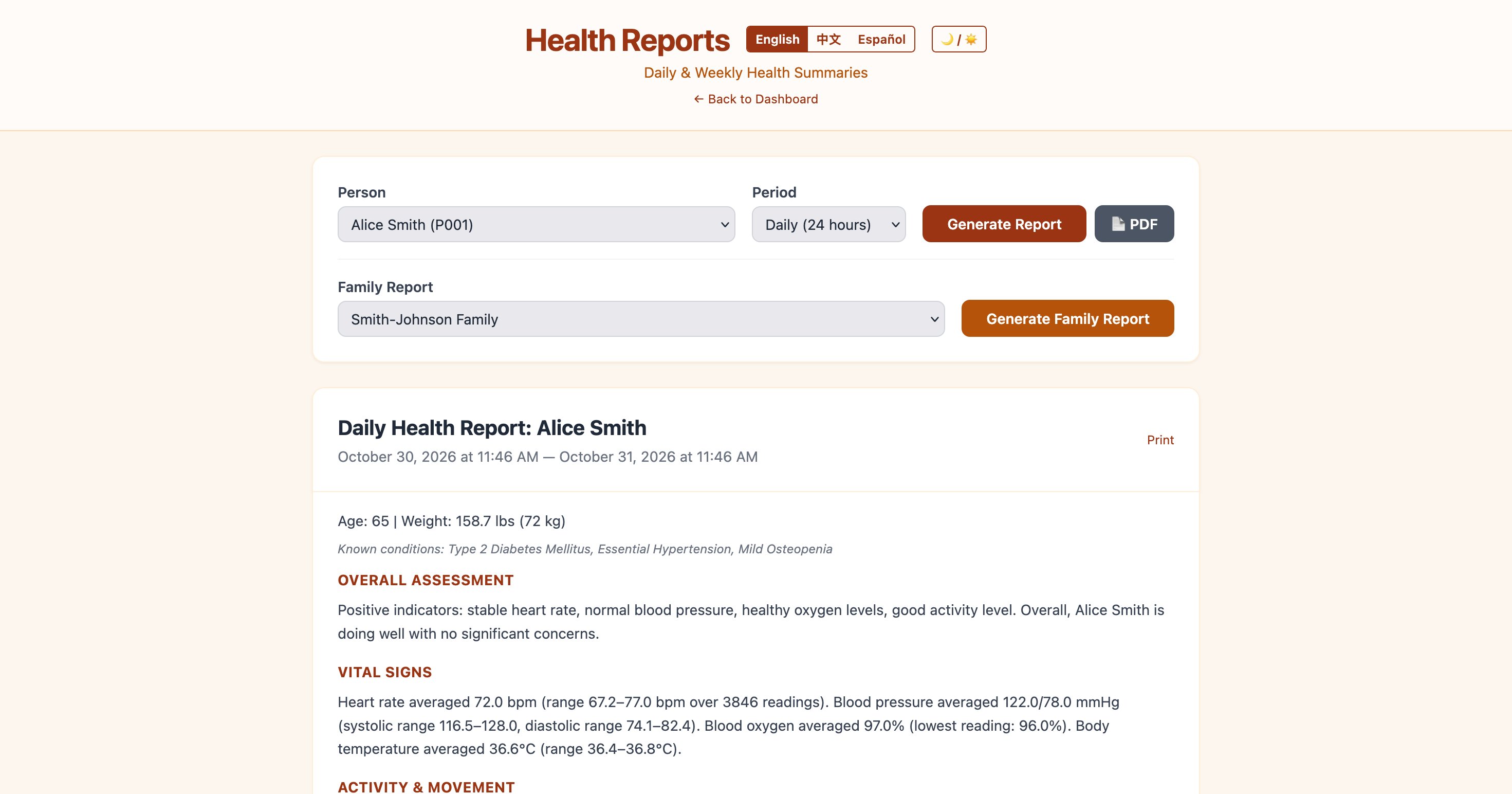
CARE ElderHome dashboard showing a daily health report: overall assessment, vital signs and activity, available in English, Chinese and Spanish
Daily health reports in plain language for care teams and families, in English, Chinese and Spanish.
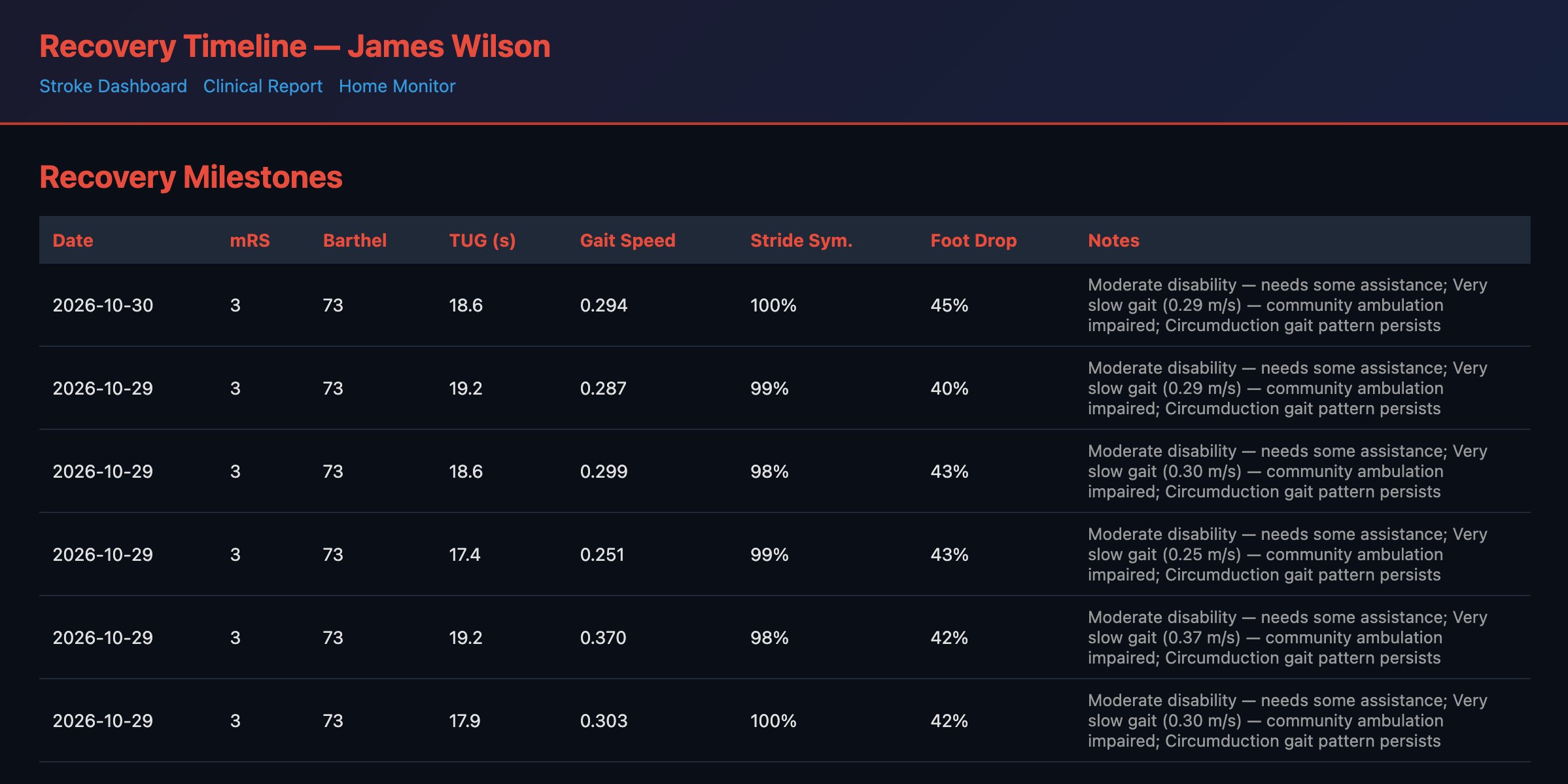
CARE ElderHome stroke recovery timeline: daily mRS, Barthel index, Timed Up and Go, gait speed, stride symmetry and foot drop measured at home
Stroke recovery tracking: gait speed, Timed Up and Go, stride symmetry and foot drop, measured at home between visits.
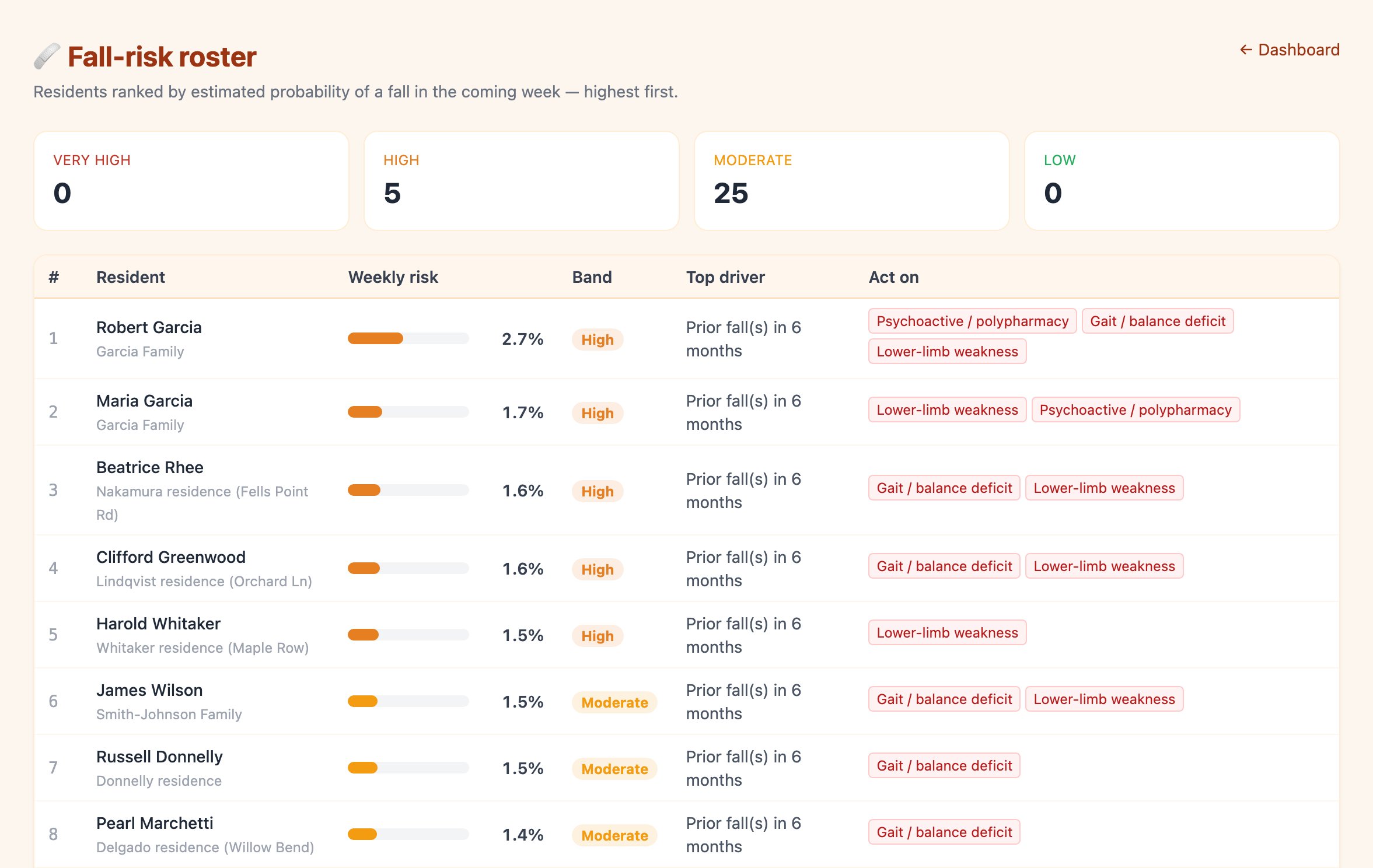
CARE ElderHome fall-risk roster ranking residents by estimated probability of a fall in the coming week, with risk band, top driver and factors to act on
Fall-risk roster: residents ranked by their chance of a fall in the coming week, with the factors a nurse can act on.
CARE ElderHome provider network view: a visiting nurse agency and a physical therapy practice with services, insurance accepted, and a live map of clinicians on visits
Provider network: visiting-nurse and therapy partners, their services and insurance, and live clinician locations for scheduling and handoffs.

Screenshots show demo data. Map data © OpenStreetMap contributors.

Built for How Care Is Delivered

  • Fits existing workflows. Alerts reach care teams by text and phone and into clinical records through FHIR, rather than another portal to watch.
  • Dashboards for clinicians and families. Each sees what they need, from risk-ranked rosters to a simple view of how a parent's day is going.
  • Standalone or embedded. Offered as a service on its own, or built into a home-health or assisted-living operator's own offering.
  • Built with reimbursement in mind. Supports documentation for CMS remote therapeutic monitoring codes, which partner physicians and therapy practices can bill for eligible patients.

See the platform at connectedcare-dx.com, or read the August 2026 announcement.

What It Means for Your Agency

Protect your value-based payments

Under the expanded Home Health Value-Based Purchasing model, Medicare adjusts each agency's payments by up to 5%, up or down, based on quality measures that include hospitalizations and emergency department use. Catching decline between visits works directly on those measures.

$

Up to $500,000 a year rides on your value-based score.

Spend visits where they matter

Medicare pays home health per 30-day period, not per visit. A ranked roster helps nurses put their time on the patients who need it, and gives the agency evidence when a patient needs more.

Remote monitoring and reimbursement

Physicians, nurse practitioners and therapy practices you work with can bill CMS remote therapeutic monitoring codes for eligible patients, and agencies can report remote monitoring costs on the Medicare cost report. Rules differ by payer, including Medicare Advantage, so we work through what applies to your patients during the pilot.

Privacy and Trust

No cameras or microphones

Motion, environmental and optional wearable sensors only. Dignity stays intact.

HIPAA by design

Encryption in transit and at rest, role-based access, and a Business Associate Agreement with every agency.

Your data stays yours

Processing starts on the home hub, and records export in the FHIR standard whenever you need them.

Built in Baltimore

Developed at MDC Studio, a medtech venture studio with in-house engineering, regulatory and clinical support.

Start With a 90-Day Pilot

A small, measurable trial with your highest-risk patients, so you can see the results in your own data before you commit.

We provide

  • Hub, sensors and connectivity for each home
  • Installation, removal and technical support
  • Nurse app and dashboards, with about two hours of training
  • Alert routing set up around your on-call process
  • A results report: readmissions, ED visits, falls and visit time

You provide

  • About 30 patients, typically recent hospital discharges with CHF, COPD, fall risk or post-surgical needs
  • A clinical champion and a few nurse users
  • Consent from patients or their caregivers
  • Outcome data for comparison, de-identified
  • A signed Business Associate Agreement

Request a pilot

Tell us about your agency and we'll reply within two business days.

Please don't include patient information. Prefer email? Write to [email protected].

Questions Agencies Ask

Who installs the equipment?

Our team installs and removes everything. Your nurses don't need to set up hardware.

Does the patient have to wear or do anything?

No. The sensors are passive. A wearable is optional for patients who want vital signs tracked, and nothing needs to be pressed or remembered.

Will my nurses be flooded with alerts?

Thresholds are set per patient against their own baseline. Routine changes update the ranked roster for the next visit; only urgent ones interrupt. During a pilot we review alert volume with you and tune it together.

Does it work with our EHR?

CARE exports alerts and trends in the FHIR R4 standard, which modern home health EHRs can receive. During the pilot we confirm the integration path for your system.

What if the home has no Wi-Fi?

Let us know when you enroll the patient and we'll work out a connection option for that home.

Is it HIPAA compliant?

Yes. We sign a Business Associate Agreement before any patient data is shared, and data is encrypted in transit and at rest with role-based access.

Does CARE diagnose or direct treatment?

No. CARE supports your clinicians' awareness of changes at home. All clinical decisions stay with your team.

What does it cost after the pilot?

Pricing is per patient per month and depends on your census and the services you choose. We'll walk through it, along with the reimbursement options that apply to your patients, before the pilot ends.

Contact Us

Get In Touch


Connected Care Systems
300 West Pratt Street, Ste 200
Baltimore, MD 21201

[email protected]

Connected Care Systems is a MDC Studio Company